An automobile or motor car (usually shortened to just car) is a wheeled passenger vehicle that carries its own motor. Most definitions of the term specify that automobiles are designed to run primarily on roads, to have seating for one to eight people, to typically have four wheels, and to be constructed principally for the transport of people rather than goods.[1] However, the term is far from precise.
As of 2002, there were 590 million passenger cars worldwide (roughly one car for every eleven people).[2]
History
Although Nicolas-Joseph Cugnot is often credited with the first self-propelled mechanical vehicle or automobile, this claim is disputed by some, who doubt Cugnot's three-wheeler ever ran, while others claim Ferdinand Verbiest, a member of a Jesuit mission in China, built the first steam powered car around 1672.[3][4] In either case François Isaac de Rivaz, a Swiss inventor, designed the first internal combustion engine which was fuelled by a mixture of hydrogen and oxygen and used it to develop the world's first vehicle to run on such an engine. The design was not very successful, as was the case with Samuel Brown, Samuel Morey, and Etienne Lenoir who each produced vehicles powered by clumsy internal combustion engines.[5]
In November 1881 French inventor Gustave Trouvé demonstrated a working three-wheeled automobile. This was at the International Exhibition of Electricity in Paris.[6]
An automobile powered by an Otto gasoline engine was built in Mannheim, Germany by Karl Benz in 1885 and granted a patent in January of the following year under the auspices of his major company, Benz & Cie. which was founded in 1883.
Although several other German engineers (including Gottlieb Daimler, Wilhelm Maybach, and Siegfried Marcus) were working on the problem at about the same time, Karl Benz is generally acknowledged as the inventor of the modern automobile.[5] In 1879 Benz was granted a patent for his first engine, designed in 1878. Many of his other inventions made the use of the internal combustion engine feasible for powering a vehicle and in 1896, Benz designed and patented the first internal combustion flat engine.
Approximately 25 Benz vehicles were built and sold before 1893, when his first four-wheeler was introduced. They were powered with four-stroke engines of his own design. Emile Roger of France, already producing Benz engines under license, now added the Benz automobile to his line of products. Because France was more open to the early automobiles, more were built and sold in France through Roger than Benz sold in Germany.
Daimler and Maybach founded Daimler Motoren Gescellschaft (Daimler Motor Company, DMG) in Cannstatt in 1890 and under the brand name, Daimler, sold their first automobile in 1892. By 1895 about 30 vehicles had been built by Daimler and Maybach, either at the Daimler works or in the Hotel Hermann, where they set up shop after falling out with their backers. Benz and Daimler seem to have been unaware of each other's early work and worked independently.
Daimler died in 1900 and later that year, Maybach designed a model named Daimler-Mercedes, special-ordered by Emil Jellinek. Two years later, a new model DMG automobile was produced and named Mercedes after the engine. Maybach quit DMG shortly thereafter and opened a business of his own. Rights to the Daimler brand name were sold to other manufacturers.
Karl Benz proposed co-operation between DMG and Benz & Cie. when economic conditions began to deteriorate in Germany following the First World War, but the directors of DMG refused to consider it initially. Negotiations between the two companies resumed several years later and in 1924 they signed an Agreement of Mutual Interest valid until the year 2000. Both enterprises standardized design, production, purchasing, sales, and advertising—marketing their automobile models jointly—although keeping their respective brands. On June 28, 1926, Benz & Cie. and DMG finally merged as the Daimler-Benz company, baptizing all of its automobiles Mercedes Benz honoring the most important model of the DMG automobiles, the Maybach design later referred to as the 1902 Mercedes-35hp, along with the Benz name. Karl Benz remained a member of the board of directors of Daimler-Benz until his death in 1929.
In 1890, Emile Levassor and Armand Peugeot of France began producing vehicles with Daimler engines, and so laid the foundation of the motor industry in France. The first American car with a gasoline internal combustion engine supposedly was designed in 1877 by George Selden of Rochester, New York, who applied for a patent on an automobile in 1879. In Britain there had been several attempts to build steam cars with varying degrees of success with Thomas Rickett even attempting a production run in 1860.[7] Santler from Malvern is recognized by the Veteran Car Club of Great Britain as having made the first petrol-powered car in the country in 1894[8] followed by Frederick William Lanchester in 1895 but these were both one-offs.[8] The first production vehicles came from the Daimler Motor Company, founded by Harry J. Lawson in 1896, and making their first cars in 1897.[8]
In 1892, German engineer Rudolf Diesel got a patent for a "New Rational Combustion Engine". In 1897 he built the first Diesel Engine.[5] In 1895, Selden was granted a United States patent(U.S. Patent 549,160 ) for a two-stroke automobile engine, which hindered more than encouraged development of autos in the United States. Steam, electric, and gasoline powered autos competed for decades, with gasoline internal combustion engines achieving dominance in the 1910s.
The large-scale, production-line manufacturing of affordable automobiles was debuted by Ransom Olds at his Oldsmobile factory in 1902. This assembly line concept was then greatly expanded by Henry Ford in the 1910s. Development of automotive technology was rapid, due in part to the hundreds of small manufacturers competing to gain the world's attention. Key developments included electric ignition and the electric self-starter (both by Charles Kettering, for the Cadillac Motor Company in 1910-1911), independent suspension, and four-wheel brakes.
Although various pistonless rotary engine designs have attempted to compete with the conventional piston and crankshaft design, only Mazda's version of the Wankel engine has had more than very limited success.
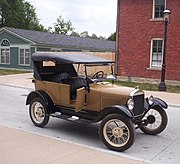
Ford Model T, 1927, regarded as the first affordable automobile
Since the 1920s, nearly all cars have been mass-produced to meet market needs, so marketing plans have often heavily influenced automobile design. It was Alfred P. Sloan who established the idea of different makes of cars produced by one company, so buyers could "move up" as their fortunes improved. The makes shared parts with one another so larger production volume resulted in lower costs for each price range. For example, in the 1950s, Chevrolet shared hood, doors, roof, and windows with Pontiac; the LaSalle of the 1930s, sold by Cadillac, used cheaper mechanical parts made by the Oldsmobile division.
Design
The design of modern cars is typically handled by a large team of designers and engineers from many different disciplines. As part of the product development effort the team of designers will work closely with teams of design engineers responsible for all aspects of the vehicle. These engineering teams include: chassis, body and trim, powertrain, electrical and production. The design team under the leadership of the design director will typically comprise of an exterior designer, an interior designer (usually referred to as stylists), and a color and materials designer. A few other designers will be involved in detail design of both exterior and interior. For example, a designer might be tasked with designing the rear light clusters or the steering wheel. The color and materials designer will work closely with the exterior and interior designers in developing exterior color paints, interior colors, fabrics, leathers, carpet, wood trim, and so on.
In 1924 the American national automobile market began reaching saturation. To maintain unit sales, General Motors instituted annual model-year design changes (also credited to Alfred Sloan) in order to convince car owners they needed a replacement each year. Since 1935 automotive form has been driven more by consumer expectations than engineering improvement.
There have been many efforts to innovate automobile design funded by the NHTSA, including the work of the NavLab group at Carnegie Mellon University.[9] Recent efforts include the highly publicized DARPA Grand Challenge race.[10]
Acceleration, braking, and measures of turning or agility vary widely between different makes and models of automobile. The automotive publication industry has developed around these performance measures as a way to quantify and qualify the characteristics of a particular vehicle. See quarter mile and 0 to 60 mph.
Fuel and propulsion technologies
Most automobiles in use today are propelled by gasoline (also known as petrol) or diesel internal combustion engines, which are known to cause air pollution and are also blamed for contributing to climate change and global warming.[11] Increasing costs of oil-based fuels and tightening environmental law and restrictions on greenhouse gas emissions are propelling work on alternative power systems for automobiles. Efforts to improve or replace these technologies include hybrid vehicles, electric vehicles and hydrogen vehicles.
Diesel
Diesel engined cars have long been popular in Europe with the first models being introduced in the 1930s by Mercedes Benz and Citroen. The main benefit of Diesels are a 50% fuel burn efficiency compared with 27%[12] in the best gasoline engines. A down side of the diesel is the presence in the exhaust gases of fine soot particulates and manufacturers are now starting to fit filters to remove these. Many diesel powered cars can also run with little or no modifications on 100% biodiesel.
Gasoline
Gasoline engines have the advantage over diesel in being lighter and able to work at higher rotational speeds and they are the usual choice for fitting in high performance sports cars. Continuous development of gasoline engines for over a hundred years has produced improvements in efficiency and reduced pollution. The carburetor was used on nearly all road car engines until the 1980s but it was long realised better control of the fuel/air mixture could be achieved with fuel injection. Indirect fuel injection was first used in aircraft engines from 1909, in racing car engines from the 1930s, and road cars from the late 1950s.[12] Gasoline Direct Injection (GDI) is now starting to appear in production vehicles such as the 2007 BMW MINI. Exhaust gases are also cleaned up by fitting a catalytic converter into the exhaust system. Clean air legislation in many of the car industries most important markets has made both catalysts and fuel injection virtually universal fittings. Most modern gasoline engines are also capable of running with up to 15% ethanol mixed into the gasoline - older vehicles may have seals and hoses that can be harmed by ethanol. With a small amount of redesign, gasoline-powered vehicles can run on ethanol concentrations as high as 85%. 100% ethanol is used in some parts of the world (such as Brazil), but vehicles must be started on pure gasoline and switched over to ethanol once the engine is running. Most gasoline engined cars can also run on LPG with the addition of an LPG tank for fuel storage and carburetion modifications to add an LPG mixer. LPG produces fewer toxic emissions and is a popular fuel for fork lift trucks that have to operate inside buildings.
Electric
The first electric cars were built in the early 1880s shortly before internal combustion powered cars appeared. For a period of time electrics were considered superior due to the silent nature of electric motors compared to the very loud noise of the gasoline engine. This supreme advantage was removed with Hiram Percy Maxim's invention of the muffler in 1897. Thereafter internal combustion powered cars had two critical advantages: 1) long range and 2) high specific energy (far lower weight of petrol fuel versus weight of batteries). The building of battery electric vehicles that could rival internal combustion models had to wait for the introduction of modern semiconductor controls and improved batteries. Because they can deliver a high torque at low revolutions electric cars do not require such a complex drive train and transmission as internal combustion powered cars. Some post-2000 electric car designs are able to accelerate from 0-60 mph (96 km/hour) in 4.0 seconds with a top speed around 130 mph (210 km/h). Others have a range of 250 miles (400 km) on the EPA highway cycle requiring 3-1/2 hours to completely charge. Equivalent fuel efficiency to internal combustion is not well defined but some press reports give it at around 135 mpg. Also, in 1996, there were a series of cars called EV1 manufatcured by General Motors, but ended in 1999.
Steam
Steam power, usually using an oil or gas heated boiler, was also in use until the 1930s but had the major disadvantage of being unable to power the car until boiler pressure was available. It has the advantage of being able to produce very low emissions as the combustion process can be carefully controlled. Its disadvantages include poor heat efficiency and extensive requirements for electric auxiliaries.[13]
Gas turbine
In the 1950s there was a brief interest in using gas turbine (jet) engines and several makers including Rover produced prototypes. In spite of the power units being very compact, high fuel consumption, severe delay in throttle response, and lack of engine braking meant no cars reached production.
Rotary (Wankel) engines
Rotary Wankel engines were introduced into road cars by NSU with the Ro 80 and later were seen in several Mazda models. In spite of their impressive smoothness, poor reliability and fuel economy led to them largely disappearing. Mazda, however, has continued research on these engines and overcame most of the earlier problems.
Future developments
Much current research and development is centered on hybrid vehicles that use both electric power and internal combustion. Research into alternative forms of power also focus on developing fuel cells, Homogeneous Charge Compression Ignition (HCCI), stirling engines[14], and even using the stored energy of compressed air or liquid nitrogen.
taken from: wikipedia


 )
)